
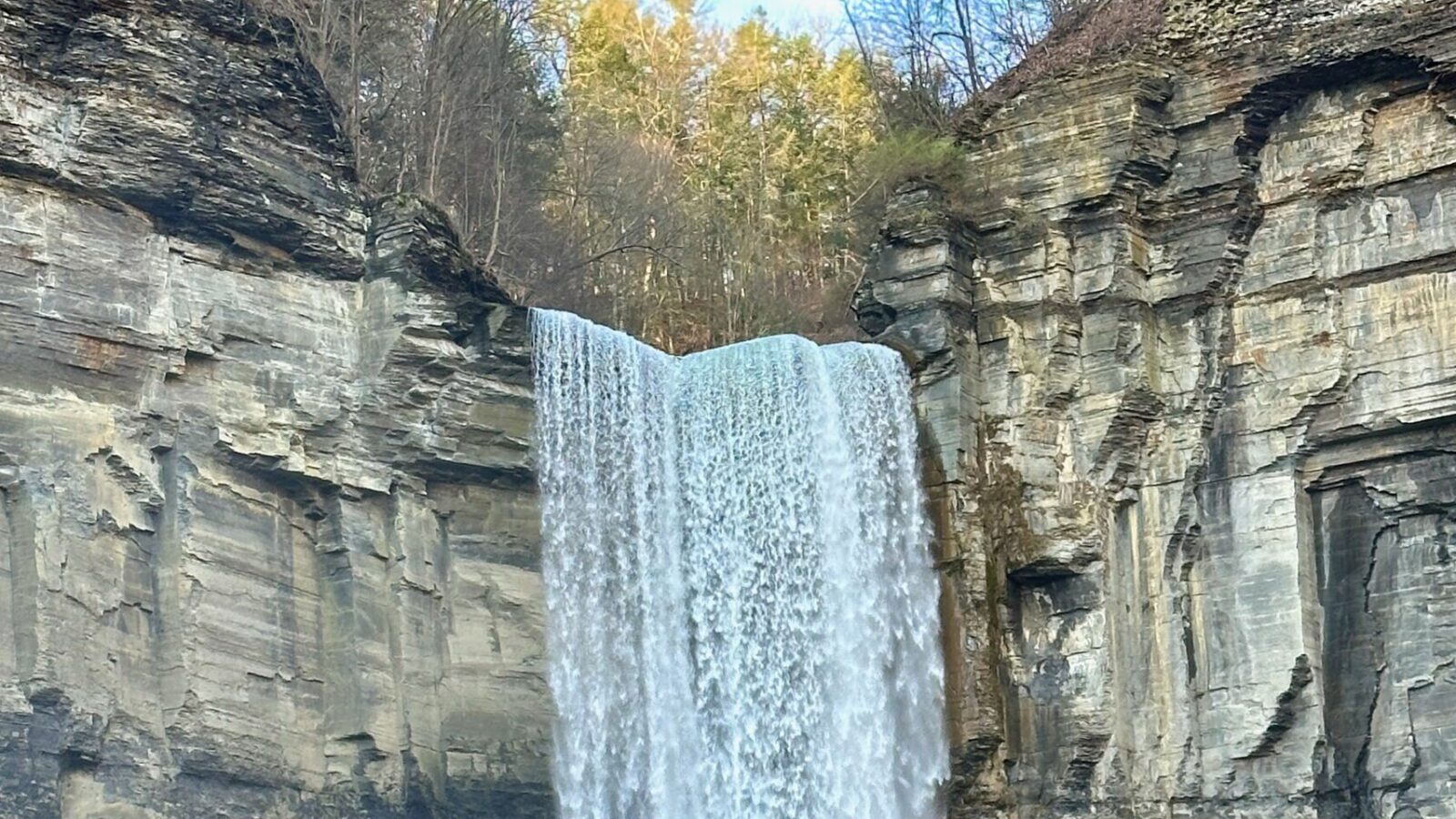
The creeks run high in March and April, and the waterfalls tend to run strong, but the Gorge Trail at Watkins Glen State Park typically does not open until mid to late May. An April waterfall trip is built around the falls you can see from the road, the gorges that happen to be open, and a call to the park before you drive.
This guide covers the weather, daylight and lake temperatures, what is open and what is not, the waterfalls, the woods and the birds, fishing, markets and wineries, and spring events. Schedules change from year to year and from one operator to the next, so confirm anything seasonal before you go. Every month at a glance is in our month-by-month guide.
Weather, daylight and the lakes
Ithaca’s April normals for 1991 to 2020 are an average high of 55 degrees Fahrenheit and an average low of 33. March averages 41 and 22, and May averages 67 and 44. April brings 3.4 inches of precipitation, spread over about 14 days, and 2.8 inches of snow, down from 12.0 inches in March and none in May. Skiing is generally finished by early April, though snow still falls.
Frost lasts well into the month. Ithaca averages 14 nights at or below 32 degrees in April, against 25 in March and 3 in May. The median date of the last freezing night is April 24 at Rochester’s airport, April 30 at the Geneva Research Farm and May 11 in Ithaca. In half of years the last freeze falls on or after those dates, so a freeze after April ends is more likely than not in Ithaca.
Days lengthen fast. Daylight runs about 12 3/4 hours on April 1 and about 14 hours on April 30, with sunset moving from about 7:30 pm to about 8 pm.
The lakes are cold. A U.S. Geological Survey gauge at the north end of Skaneateles Lake recorded April water temperatures in the mid-40s Fahrenheit in 2021, 2023, 2024 and 2025. That is one gauge on one lake. Seneca Lake is 38 miles long, up to about 3 miles wide and 618 feet deep, and it holds more water than any other Finger Lake.
What is open and what is not yet
The Gorge Trail at Watkins Glen typically opens for the season in mid to late May and closes in mid to late October, depending on the weather. The park itself is open year round, and the north and south rim trails stay open, but from the rims there is no access to the gorge or its waterfalls from November to May. Camping, the pool and the gift shop open in May or later. Our Watkins Glen Gorge Trail guide covers the trail and its season, and our guide to the state parks and gorges covers the rest.
Other gorges are decided park by park and year by year. One spring, all of the trails at Taughannock Falls State Park were open by mid-April and Cornell Botanic Gardens opened the Cascadilla Gorge and Beebe Lake trails in late April, while the gorge trails at Robert H. Treman State Park and Buttermilk Falls State Park were closed in April for hazardous conditions. The lower Cascadilla Gorge closes each winter and reopens in the spring when conditions allow. Taughannock’s gorge trail runs about three-quarters of a mile to a waterfall that plunges 215 feet. Check each park’s trail update, or call, before you drive.
Scheduled lake cruises generally start in May, so check each operator. Falling Waters Boat Tours on Seneca Lake runs from May through October, and The Canandaigua Lady sails from May through October. The state canal system, which includes the Cayuga-Seneca Canal, opens to boats in mid-May. Seneca Lake State Park keeps its boat launch open year round.
Some museums and historic sites run reduced schedules in April. The Glenn H. Curtiss Museum in Hammondsport is open in April except on Easter. At the Mark Twain Study, a docent is on duty only from Memorial Day to Labor Day, though visitors can walk up and look inside the rest of the year. The church and parsonage at Harriet Tubman National Historical Park are open seasonally on Fridays and Saturdays, so call the park to confirm April access. Stonecat Cafe in Hector is generally open from early April through mid-November, so confirm before you go.
Why the creeks run high
Snowmelt and spring rain keep the creeks full. Records from the U.S. Geological Survey gauge on Fall Creek near Ithaca average about 402 cubic feet of water per second in April for 1991 to 2020, roughly four times the July average of 100. March is close behind at 369, and over the full record from 1925 the two months are nearly tied. Sixmile Creek at Brooktondale shows the same pattern, with March slightly above April and both about three times July. The high-water season runs from March into April, and any given day depends on recent rain and melt. These gauges measure creeks, not individual waterfalls.
The same water makes gorges dangerous. Spring currents in the gorges can be turbulent, heavy rain on melting snow raises creek levels, and the water’s edge is no place to stand after a downpour. Fast water makes stream crossings on trails dangerous, and rocks can be icy from spray.
Falls you can see without a gorge trail are the April answer. Hector Falls drops beside Route 414 on the east shore of Seneca Lake, about 3.5 miles north of Watkins Glen, and the upper part can be seen from the Route 414 bridge. There is no formal viewpoint or parking lot, crossing the road takes care, and the land near the base is private, so the base is seen from the water. Aunt Sarah’s Falls stands at the entrance to Montour Falls on Route 14 and is listed at about 90 feet, in three tiers. It flows well only when the water is high and is usually dry or nearly so in summer, so spring and the days after heavy rain are the time to go. The parking lot is across Route 14 from the falls, with no official crosswalk as of 2023, so use care at the road.
In the village, She-Qua-Ga Falls sits at the end of West Main Street and gives Montour Falls its name. The water flows under the Mill Street Bridge into a pool in Shequaga Falls Park, which has a short trail, benches and picnic tables. Deckertown Falls is a three-tiered waterfall on Catlin Mill Creek, at the end of a short trail from a small lot at the end of East Catlin Street. Steep drop-offs line the trail, and seeing the middle drop and the upper falls takes some scrambling. Public land runs up the trail to the Route 224 bridge, and the land beyond it is private.
More waterfall stops are on public land. Grimes Glen in Naples is a county park with two 60-foot waterfalls about a half mile upstream from the parking area. Expect to get your feet wet, and expect spring runoff to come on strong and turbulent. Carpenter Falls Unique Area in the Town of Niles is open year round, with a boardwalk of about 600 feet to an accessible platform over the Upper Falls, which DEC puts at about 90 feet. Eagle Cliff Falls at Havana Glen Park sits in a seasonal town park, so confirm access with the Town of Montour before you go. More falls are in every waterfall worth seeing in the Finger Lakes.
Hiking, birds and wildflowers
Spring is mud season at Finger Lakes National Forest. It is usually short but intense, and hiking on wet trails is discouraged. The Forest Service’s guidance for the Green Mountain and Finger Lakes National Forests together puts mud from the first snowmelt until roughly Memorial Day and warns that an open trail is not necessarily a passable one. The forest’s Backbone Trail is open year round for hiking, but horseback riding there is not allowed from March 15 to May 1 because of mud. Our best hikes guide has more trails.
April is waterfowl season at Montezuma National Wildlife Refuge. Spring migration there runs from late February through April, with Canada and snow geese in the tens of thousands and many kinds of ducks stopping on their way north. Bald eagles generally hatch around mid-April. The Wildlife Drive opens on April 1, weather permitting, and runs through November. From December through March it is closed to driving, cycling and walking. Most of the Seneca Trail is closed through August to protect bald eagles. Shorebirds are common from early May, and warblers peak in mid-May.
Daffodils bloom across Cornell Botanic Gardens in April, with flowering cherries soon after, and the weather moves the timing. Mundy Wildflower Garden, a Cornell natural area along Fall Creek, is known for skunk cabbage, trout lily, marsh marigold and trillium, which bloom before the trees leaf out. The Judd Falls Road entrance has a moderately steep staircase.
Fishing and paddling
April 1 opens trout stream and Finger Lakes tributary fishing. On inland trout streams the keeping season runs from April 1 to October 15, and from October 16 through March 31 those streams are catch and release with artificial lures only. Brook trout in lakes and ponds also open April 1. Finger Lakes tributaries are closed to fishing from January 1 through March 31, except on listed sections. The tributary season for trout and landlocked salmon, including Naples Creek and the other tributaries of Canandaigua Lake, runs from April 1 through December 31, with a 15-inch minimum, a limit of three fish in combination and no more than one rainbow trout. Fishing on those tributaries is prohibited between sunset and sunrise from April 1 to May 15, except on listed sections.
The lakes themselves have their own rules, and several trout and salmon species are open all year. Brown trout, rainbow trout, lake trout and Atlantic salmon are all-year species on Seneca, Keuka, Canandaigua, Canadice, Conesus and Hemlock lakes under special regulations. The statewide lake trout season of April 1 to October 15 applies only to waters without such a rule. Walleye and northern pike are closed in April and reopen May 1. Black bass are catch and release only, with artificial lures, from March 16 to June 14. Special regulations on a specific water can differ, so check the state Department of Environmental Conservation before you fish, and see our fishing guide for spots.
The spring run of rainbow trout draws anglers to Naples Creek, Catharine Creek, Grout Brook, Cayuga Inlet, Owasco Inlet, Cold Brook Stream and Springwater Creek. Adult rainbows migrate from Canandaigua Lake into the Naples Creek system each spring to spawn. Catharine Creek empties into Seneca Lake at Watkins Glen and has an annual spring migration of wild rainbow trout. Anglers 16 and older need a freshwater fishing license, valid for 365 days from purchase.
Paddlers face the same cold. Everyone on a pleasure boat under 21 feet must wear a life jacket from November 1 to May 1, which covers all of April, and children under 12 must always wear one on a watercraft. Cold water can quickly lower core body temperature and lead to hypothermia, and even in the first few weeks of spring the water is still very cold.
Markets, wineries and farms
The Ithaca Farmers Market opens its outdoor season in April with a Saturday market at the Steamboat Landing pavilion, and it runs Saturdays through December. Sundays and the Wednesday market at East Hill Plaza start in May. The market first opened on Saturdays in 1973, and its vendors must grow or produce what they sell within 30 miles of the pavilion. Geneva’s Saturday market opens in late May, and Canandaigua’s opens on the first Saturday in June.
Joseph’s Wayside Market in Naples opens for the season on the last Friday in April and closes on the first Sunday in November. Its three greenhouses grow the flowers for spring planting. For farm stands and u-pick farms later in the season, see our farm stands and u-pick guide, and call a farm before you drive out, because crop timing shifts with the weather.
Many Finger Lakes tasting rooms are open all year. Dr. Konstantin Frank Winery, Hermann J. Wiemer Vineyard and Thirsty Owl Wine Company keep their tasting rooms open all year, and the wineries of the Keuka Lake Wine Trail are open year round, with hours that vary. Some trim their winter and spring days. Wagner Vineyards shortens its week from November to mid-March, and Heart & Hands Wine Company keeps tastings to weekends from mid-February to late May. Our best wineries guide has the full list.
Spring events and weekends
Easter moves. It falls on the first Sunday after the first ecclesiastical full moon on or after March 21, so it can land anywhere from March 22 to April 25. The Ward W. O’Hara Agricultural and Country Living Museum in Auburn lists an annual Easter Egg Scavenger Hunt among its seasonal programs, so ask the museum for its dates.
Two wine trails hold ticketed spring weekends. The Seneca Lake Wine Trail’s Spring Wine & Cheese fell on a mid-April weekend in 2024 and 2026, with self-guided winery visits and cheese and wine pairings, and the 2024 weekend admitted guests 21 and older only. The Cayuga Lake Wine Trail’s Wine & Herb Weekend, in its 32nd year in 2026, covered the last weekend of April and the first weekend of May in both 2025 and 2026, with 10 wineries. The 2026 weekends included Buttonwood Grove Winery, Hosmer Winery, Sheldrake Point Winery and Montezuma Winery & Hidden Marsh Distillery. The dates shift from year to year, so check each trail’s calendar.
The Finger Lakes Reptile & Exotics Expo is held twice a year, in April and October, at the Finger Lakes Mall Event Center in Auburn. New York’s statewide Maple Weekend is held in March, ahead of April.
Practical tips
- Check the park’s trail update or call before you drive to any gorge. Opening dates change from year to year.
- Book ahead where tickets are involved. The wine trail weekends are ticketed, and guided tours at the Curtiss Museum should be booked two weeks ahead.
- Pack for mornings near 33 degrees and for rain on about 14 days of the month in Ithaca. Waterproof boots matter on wet trails and at the roadside falls.
- Protect against ticks. Adult deer ticks can be active at temperatures as low as 40 degrees Fahrenheit, and deer tick nymphs, which are about the size of a poppy seed, are out from April through late June or early July. Wear light-colored clothing, use repellent or permethrin-treated clothing, and check your whole body afterward.
- Drive with care at the roadside falls. Hector Falls has no formal parking, and Aunt Sarah’s Falls has a lot across Route 14 with no official crosswalk.
- Plan around the light. Sunset is near 8 pm by the end of the month, which leaves room for a late hike.