The Trail at a Glance
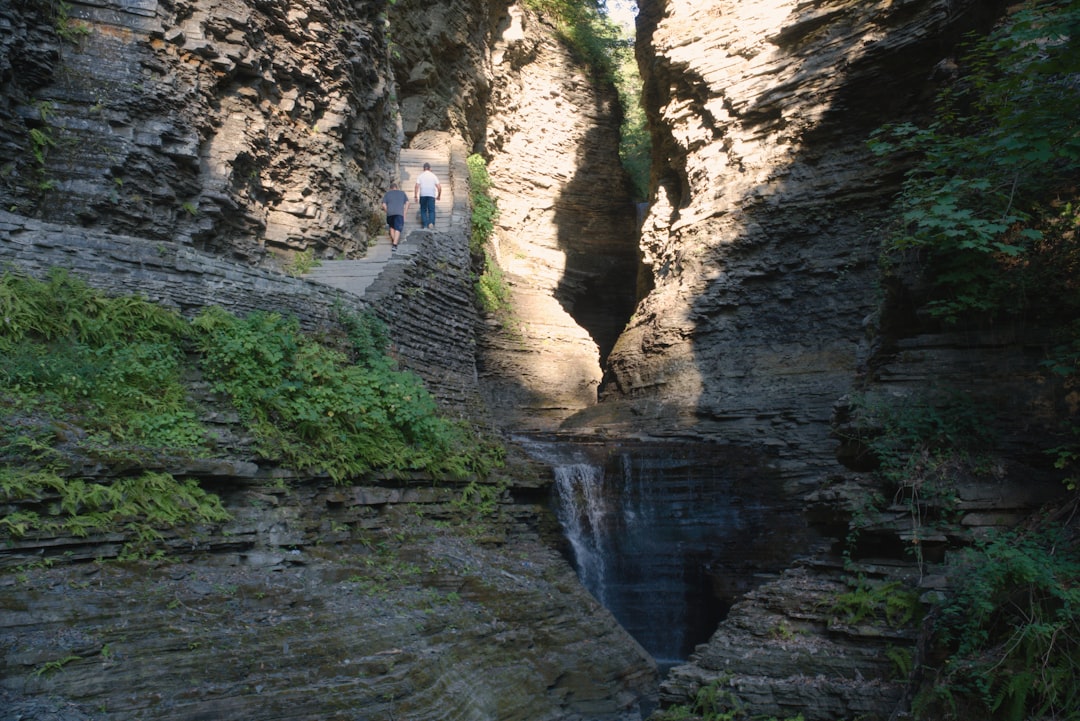
The Gorge Trail at Watkins Glen State Park is a 2-mile path that climbs 832 stone steps through a narrow canyon with 19 waterfalls, 200-foot-high rock walls, and a point where you walk directly behind a curtain of falling water. The trail gains roughly 400 feet of elevation from the main entrance at the village edge to the upper entrance at the top of the park. It draws over a million visitors per year to a village of 1,800 people. There is nothing else quite like it in the northeastern United States, and if you visit the Finger Lakes, this is the one thing nearly everyone will tell you not to skip.
What You’ll See
The Gorge Trail runs from the lower entrance (at the south end of the village of Watkins Glen, off North Franklin Street) to the upper entrance (on Route 329). The most dramatic section is the lower half — from the entrance to the Spiral Tunnel. Within the first quarter mile, the stone walls close in on both sides, the air temperature drops, and the sound of water becomes constant.
Cavern Cascade
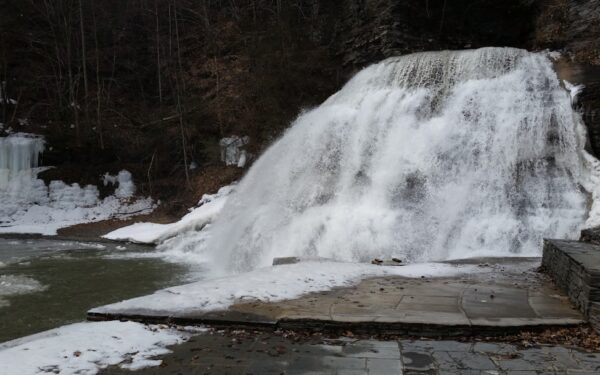
The signature moment comes about a third of the way through: Cavern Cascade, where the trail passes directly behind a sheet of falling water. The path cuts through an overhang in the rock, and the waterfall drops in front of you like a curtain. You will get misted. On a hot July afternoon, that mist is the best thing that will happen to you all day. On a cool October morning, it adds atmosphere that borders on theatrical.
The Spiral Tunnel
Past Cavern Cascade, the trail enters a tunnel carved through solid rock — the Spiral Tunnel — that spirals upward through the stone. This is where the engineering of the trail becomes as impressive as the geology. The Civilian Conservation Corps rebuilt much of the path in the 1930s, and their stonework remains intact 90 years later.
The Upper Gorge
Above the Spiral Tunnel, the gorge widens slightly and the waterfalls continue — smaller cascades and pools that are less dramatic than the lower section but still worth the climb. The final stretch leads to the upper entrance, where a parking lot, restrooms, and a shuttle stop provide options for the return trip.
Difficulty and Fitness
The trail is rated as strenuous by the park, and that rating is accurate. The 832 stone steps are uneven, often wet, and sometimes slippery despite grip-textured surfaces. The continuous climb is not steep at any single point, but the cumulative elevation gain — about 400 feet over 2 miles — adds up. Expect to feel it in your legs, especially on the return if you walk back down.
Most reasonably fit adults can complete the trail. The full out-and-back (down and up if you enter from the top, or up and down from the bottom) takes 1.5 to 2 hours at a moderate pace with photo stops. People with knee problems, mobility limitations, or significant fear of heights should consider the Rim Trail instead (see below). The trail is not accessible for wheelchairs or strollers.
Timing Your Visit
Best Time of Day
Before 10 AM or after 4 PM. The gorge faces roughly east-west, and morning light filtering into the canyon creates the best conditions for both experience and photography. More importantly, midday in July and August can feel like walking through a theme park queue — the trail is narrow in many sections, and passing is difficult when hundreds of people are packed in. An early morning visit on a weekday is a different experience entirely: quiet enough to hear individual water drops echoing off the stone.
Best Season
Late May through mid-October. Water flow is highest in spring (late May and June), which makes the waterfalls more dramatic but the steps wetter. Summer (July and August) brings the heaviest crowds but the most reliable weather. Early fall (September and October) is the sweet spot — smaller crowds, fall color on the rim, and comfortable temperatures. The gorge deepens the autumn palette, with orange and red leaves framed against gray stone and white water.
Seasonal Closure
The Gorge Trail typically closes in early November and reopens in mid-May, depending on weather. Ice formation on the steps and rock walls makes winter access dangerous, and the park closes the gorge floor trail entirely during the off-season. The exact opening and closing dates vary each year — check the New York State Parks website or call the park office before planning a spring or late-fall visit.
Practical Details
Parking
The main lot at the lower entrance (off North Franklin Street) holds roughly 100 cars and charges $10 per vehicle from Memorial Day through Columbus Day. On summer weekends, this lot fills by 10 AM — sometimes earlier on holiday weekends. When it’s full, an overflow lot and street parking in the village become the options. The upper entrance on Route 329 has a larger lot that fills later in the day. Park there and walk down, then shuttle back up.
Pro tip: the park opens at sunrise, and the parking fee booth is not staffed in the earliest hours. Arriving at 7:30 or 8 AM on a summer morning gets you a parking spot, a quiet trail, and often no fee.
The Shuttle
A shuttle bus runs between the upper and lower entrances during peak season (typically late June through Labor Day, and weekends through October). The shuttle is free with park admission and runs every 10 to 15 minutes. This allows you to walk the gorge one way — up from the bottom is the standard direction — and ride back without retracing your steps.
What to Wear
Shoes with grip. This is non-negotiable. The stone steps are wet for most of the trail’s length, and smooth-soled shoes are a recipe for a hard landing. Trail runners, hiking boots, or any shoe with a textured rubber sole will do. Flip-flops and dress shoes are technically not prohibited, but they should be. Bring a light rain jacket or accept that you’ll get misted at Cavern Cascade.
No Dogs on the Gorge Trail
Dogs are not permitted on the Gorge Trail. This is strictly enforced. Dogs are allowed on the Rim Trail and South Rim Trail above the gorge, both of which offer views down into the canyon. If you’re traveling with a dog, plan for the rim trails or leave your pet at your lodging for the gorge visit.
The Rim Trail Alternative
If the Gorge Trail is too strenuous, too crowded, or you’re traveling with a dog, the Rim Trail runs along the south side of the gorge and provides aerial views straight down into the canyon from several overlook points. The Indian Trail runs along the north rim. Both are less dramatic than walking the gorge floor — you’re looking down rather than looking up — but they’re less crowded, less strenuous, and open to dogs on leash. The Rim Trail connects the lower and upper entrances and can be combined with a one-way gorge walk for a full loop.
Photography Tips
The gorge is a challenging and rewarding place to photograph. The light contrast is extreme — bright sky above, deep shade on the gorge floor — and the mist from waterfalls can fog lenses quickly.
- Bring a microfiber cloth and wipe your lens after every waterfall encounter. Mist accumulates faster than you think.
- Go early for the best light. Morning sun enters the gorge at a low angle and illuminates the waterfalls against the dark stone walls. By midday, the gorge floor is in full shade.
- A polarizing filter cuts glare on wet rock and deepens the color of the water. If you’re shooting with a camera rather than a phone, this is the single most useful accessory for the gorge.
- Slow shutter speeds (1/4 second or longer) turn the waterfalls into silky curtains, but you’ll need a small tripod or a very steady hand. The stone railings along the trail provide improvised support.
- Phone cameras work well here. The gorge is dramatic enough that even a basic smartphone captures the scale. Portrait mode struggles with the mist and spray — switch to standard mode for reliability.
What Else Is Nearby
Watkins Glen sits at the southern tip of Seneca Lake. After the gorge, the Seneca Lake Wine Trail starts within a 5-minute drive heading north on either shore. Hector Falls, a 165-foot cascade visible from Route 414 about five miles north, takes 30 seconds to see from a roadside pull-off. The International Motor Racing Research Center on Decatur Street in the village is a small but focused museum documenting the motorsport history that gives Watkins Glen its second identity. And if you’re building a full weekend, our Finger Lakes weekend itinerary starts with the gorge on Day 2 for good reason — it’s the punctuation mark the trip needs.
The History of the Trail
The gorge opened to tourists in 1863, when a journalist named Morvalden Ells built a wooden pathway along the creek and charged 25 cents admission. The original wooden infrastructure was gradually replaced with stone, and the Civilian Conservation Corps rebuilt much of the trail during the 1930s. Their stonework — hand-laid steps, retaining walls, and tunnels cut through solid rock — has held up for nearly a century and remains the backbone of the trail today. The CCC crews also built the stone bridge at Cavern Cascade and the Spiral Tunnel, both of which are now among the most photographed features in any New York state park.
The gorge itself is roughly 300,000 years old, carved through Devonian-era rock laid down approximately 380 million years ago as sediment at the bottom of a shallow sea. The fossils visible in the rock walls along the trail — brachiopods, crinoids, and occasional trilobite fragments — are a reminder that this landscape has been in motion far longer than the trail has existed. The combination of human engineering and geological time is what makes walking the gorge feel different from any other hike in the region. You are walking through deep time on hand-built stone.