A City Where Free Is Not a Consolation Prize
In most tourist towns, “free things to do” is a polite way of saying “things to do when you have run out of money.” Ithaca is different. The best experiences here — gorge trails with 200-foot shale walls, a waterfall taller than Niagara, a university campus that doubles as a botanical garden, a farmers market on the lakeshore — are genuinely free. The landscape does the heavy lifting. Here is everything worth doing in and around Ithaca that costs nothing.
Gorge Trails and Waterfalls
Cascadilla Gorge
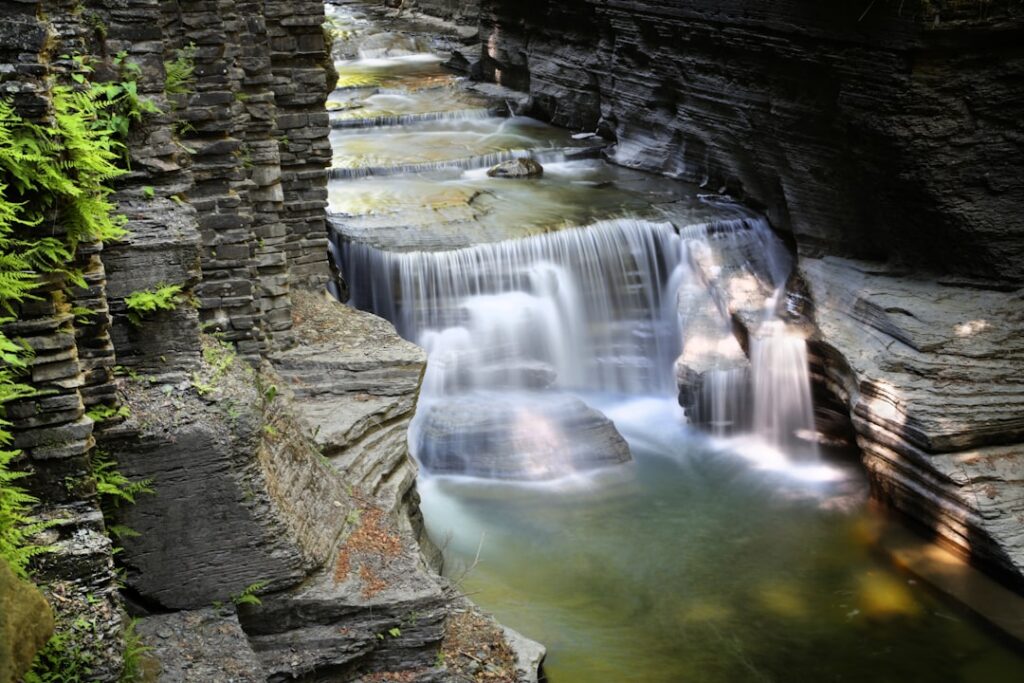
Cascadilla Gorge runs from the edge of the Cornell campus at College Avenue down to downtown Ithaca at Court Street — roughly a mile of stone steps, bridges, and eight waterfalls carved into layers of Devonian-era shale. This is the gorge you can walk during a lunch break. The trail descends about 400 feet through a narrow canyon, with the creek rushing alongside and water dropping over ledges every few hundred yards. No vehicle fee, no entrance gate, no park boundary to cross. Just walk in from either end.
The trail is open seasonally (typically May through November) and closes in winter due to ice. The stone steps are uneven and often wet — shoes with grip are non-negotiable. The walk takes about 30 to 45 minutes one way at a moderate pace. Start at the top (College Avenue, near the Cornell campus) and walk down — it is easier on the knees and the waterfalls unfold in front of you.
Taughannock Falls State Park — Gorge Trail
The Taughannock Falls Gorge Trail is a flat, three-quarter-mile walk from the parking area to the base of a 215-foot waterfall — 33 feet taller than Niagara Falls. The trail follows Taughannock Creek through a widening gorge, with shale walls rising on either side until you reach the amphitheater at the base of the falls. The trail is paved and level enough for strollers and wheelchairs for most of its length. It is one of the most accessible major waterfall hikes in the Northeast.
The park is 10 miles north of Ithaca on Route 89. There is a vehicle entrance fee ($7 to $10) on summer weekends, but the fee is seasonal and not charged during weekdays in the off-season. From mid-October through May, entrance is typically free. Even in summer, the gorge trail itself has no separate admission. If you park on Route 89 outside the park entrance and walk in, you avoid the vehicle fee entirely — the trailhead is a short walk from the roadside pull-offs. For a full breakdown of all the major cascades in the region, see our Finger Lakes waterfalls guide.
Ithaca Falls
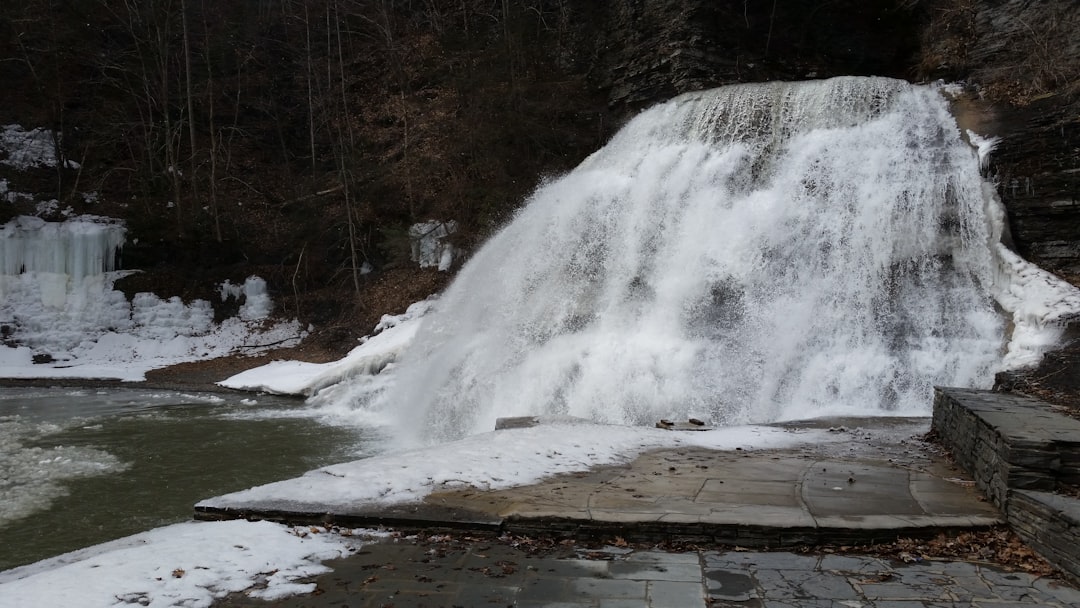
Ithaca Falls is a 150-foot-wide, 100-foot-tall waterfall on Fall Creek, roughly a mile from the Ithaca Commons. Walk or drive to the intersection of Lake Street and Falls Street, and a short path leads to a viewing area at the base. There is no fee, no entrance gate, and no park infrastructure — just a waterfall of considerable size at the edge of a residential neighborhood. The falls run hardest in spring and after heavy rains. In late summer during dry years, the flow diminishes but the rock face remains dramatic. Total time: 15 minutes, including the walk from the nearest parking.
Buttermilk Falls State Park — Lower Falls Viewpoint
The main waterfall at Buttermilk Falls State Park — a 165-foot cascade flowing over a series of rock ledges into a natural pool — is visible from the park entrance area without hiking the gorge trail. The falls are right there when you pull in. The gorge trail itself, climbing steeply past 10 waterfalls in about a mile, is also free to walk. A vehicle entrance fee ($7 to $10) applies on summer weekends. Off-season and weekday visits are often free. Swimming in the natural pool at the base of the falls is free when the swimming area is open (lifeguards on duty from late June through Labor Day).
Robert H. Treman State Park — Lower Falls
The lower entrance of Robert H. Treman State Park provides immediate access to Lower Falls and the swimming hole at its base. The falls drop about 20 feet into a wide, creek-fed pool surrounded by shale walls — one of the best natural swimming spots in the Finger Lakes. No separate fee beyond the vehicle entrance charge on summer weekends. The full gorge trail, climbing 2 miles past 12 waterfalls to Lucifer Falls (115 feet), is also free to hike. The park is 5 miles south of downtown Ithaca on Route 13.
The Cornell Campus
Cornell Botanic Gardens
The Cornell Botanic Gardens encompass 3,600 acres of natural areas and cultivated gardens across the Cornell campus and surrounding lands. The cultivated gardens near the main campus include a wildflower garden, a poisonous plants garden, a heritage crop garden, and extensive collections of trees and shrubs. The natural areas include gorges, forests, and wetlands. All of it is free and open to the public during daylight hours, year-round. The Nevin Welcome Center on Plantations Road has maps and seasonal information.
Herbert F. Johnson Museum of Art
The Johnson Museum of Art on the Cornell campus, designed by I.M. Pei, houses a collection of over 40,000 works spanning Asian, European, American, and contemporary art. Admission is free. The building itself is worth visiting for the architecture — a concrete cantilever that projects out over the hillside, with fifth-floor windows framing a view north over Cayuga Lake. Open Tuesday through Sunday. Plan 45 minutes to an hour for a thorough visit.
Fall Creek and Suspension Bridge
Walk across the Fall Creek Suspension Bridge on the north side of the Cornell campus for a view 140 feet down into the gorge below. The bridge connects the north and central campus and is open to pedestrians at all times. It is genuinely vertiginous — the mesh railings let you see straight down to the water. From the bridge, you can follow paths along Fall Creek to several smaller waterfalls within the campus. Triphammer Falls, a 60-foot cascade next to Beebe Lake, is a two-minute walk from the bridge and drops right beside a campus building.
The Ithaca Farmers Market
The Ithaca Farmers Market at Steamboat Landing on the Cayuga Lake waterfront is free to attend and costs nothing unless you buy something — though resisting the wood-fired pizza, fresh cider donuts, and Ethiopian injera takes more discipline than most visitors can muster. The market runs Saturdays (9 a.m. to 3 p.m.) from April through December, with additional market days in summer. More than 125 vendors set up under a covered pavilion, and the setting — directly on the lake, with boats in the adjacent marina — is part of the draw. Even if you buy nothing, the sensory experience of walking through rows of produce, flowers, baked goods, and prepared food from a dozen cuisines is one of the best things to do in Ithaca on a Saturday morning.
Walking the Ithaca Commons
The Ithaca Commons is a two-block pedestrian mall along State Street in downtown Ithaca. The sidewalks are heated in winter (a feature that has prevented ice and kept foot traffic moving since the system was installed in the 1970s). The Commons is lined with independent bookstores (Buffalo Street Books, Autumn Leaves Used Books), record shops, restaurants, and small galleries. Window shopping is free. People-watching is excellent. The mix of Cornell students, local artists, Ithaca’s sizable progressive community, and visiting tourists creates a street scene with more personality per square foot than most cities ten times Ithaca’s size.
Stewart Park
Stewart Park occupies the northeast corner of Cayuga Lake’s southern tip, right in Ithaca. The park has a free swimming area with a sandy beach (no lifeguard), a playground, a historic restored carousel pavilion, picnic tables, and a fishing pier. The sunsets from Stewart Park — looking north over 38 miles of Cayuga Lake — are among the best in the Finger Lakes. Parking is free. Open year-round, though the swimming area is seasonal.
Six Mile Creek Natural Area
Six Mile Creek Natural Area is a 36-acre gorge and forest preserve within the city limits, managed by the city of Ithaca. A network of trails follows Six Mile Creek through a wooded gorge past several small waterfalls and dramatic rock formations. The main loop takes about an hour. The trailhead is on Giles Street, a short walk from the south end of the Commons. This is the gorge trail that locals use for a quick afternoon walk — less famous than the state parks but surprisingly scenic and rarely crowded.
Free Museum Days and Permanent Free Attractions
The Johnson Museum of Art at Cornell is always free. The Cornell Lab of Ornithology at Sapsucker Woods, 4 miles northeast of campus, has free access to its visitor center, bird observation room overlooking a pond, and the surrounding trail system through 220 acres of forest and wetland. The trail loop is about 2.5 miles and is excellent for birdwatching — more than 230 species have been recorded here. The Ithaca Sciencenter on First Street offers free admission on the first Thursday evening of each month (5 to 8 p.m.).
Seasonal Free Events
Ithaca runs a series of free outdoor events through the summer. Concerts in the Park at DeWitt Park happen Thursday evenings from June through August. The Ithaca Festival, typically held the first weekend in June, fills the Commons and surrounding streets with live music, art, and performances — much of it free. Apple Harvest Festival on the Ithaca Commons in late September or early October is free to attend, with apple cider, local food vendors, and live music. Check the Ithaca Events calendar for current dates.

Practical Notes
Most gorge trails are open mid-May through early November. The Cornell Botanic Gardens and the Lab of Ornithology are open year-round. Parking downtown is metered on weekdays (free evenings and Sundays). The Green Street garage is the most convenient option for the Commons and costs a few dollars for a half-day. All state park gorge trails require shoes with grip — wet stone is standard, not exceptional. Bring a water bottle and a rain layer regardless of the forecast.
For more on planning an Ithaca trip, our long weekend in Ithaca itinerary covers three days of gorges, food, and wine. And our Cayuga Lake guide puts Ithaca in the context of the broader lake and wine trail.