Two Gorges, Two Different Things
Watkins Glen State Park and Letchworth State Park are the two most celebrated gorge landscapes in New York State, and they appear on the same “best of” lists so often that visitors assume they are interchangeable. They are not. These are fundamentally different places that reward different interests, different fitness levels, and different travel styles. Watkins Glen puts you inside a narrow canyon, walking behind waterfalls on hand-built stone steps. Letchworth positions you above a wide river gorge, looking down from overlooks at waterfalls and forested cliffs. One is intimate and immersive. The other is sweeping and panoramic. Both are worth seeing, but if you only have time for one, the right choice depends on what you are actually after.
The Basics
Watkins Glen State Park
- Location: Southern tip of Seneca Lake, village of Watkins Glen. Central Finger Lakes.
- Gorge length: 2 miles
- Gorge depth: Up to 200 feet
- Waterfalls: 19, including Cavern Cascade (walk-behind)
- Main trail: Gorge Trail, 832 stone steps, approximately 400 feet of elevation gain
- Annual visitors: Over 1 million
- Season: Gorge Trail open mid-May through early November (weather dependent)
- Vehicle fee: $10 in peak season
Letchworth State Park
- Location: Genesee River valley, about 35 miles south of Rochester. Western edge of Finger Lakes region.
- Gorge length: 17 miles
- Gorge depth: Up to 550 feet
- Waterfalls: 3 major (Upper Falls 70 feet, Middle Falls 107 feet, Lower Falls 70 feet), plus several smaller cascades
- Trail system: Over 60 miles of trails, from easy overlook walks to strenuous gorge-floor descents
- Annual visitors: Over 1 million
- Season: Park open year-round; some trails close seasonally
- Vehicle fee: $10 year-round
The Experience: What Each Gorge Feels Like
Watkins Glen: Walking Inside the Earth
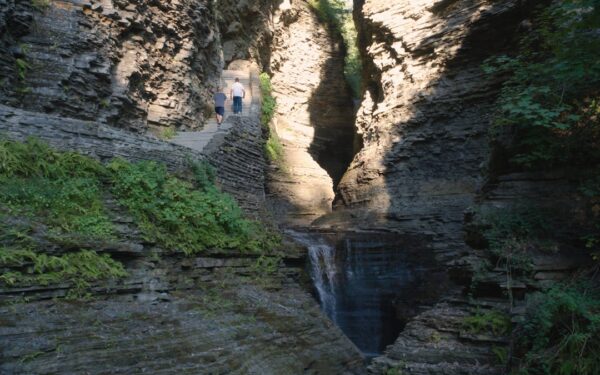
The defining quality of Watkins Glen is immersion. The gorge is narrow, sometimes barely 20 feet across, with 200-foot walls rising on both sides. The trail runs along the gorge floor, following the creek through a corridor of layered shale and sandstone. Within the first quarter mile, the stone walls close in, the air temperature drops, the sound of water becomes constant, and the outside world disappears. At Cavern Cascade, about a third of the way through, the trail passes directly behind a sheet of falling water. You will get wet. The Spiral Tunnel, where the path corkscrews through solid rock, reminds you that this trail was hand-built by the Civilian Conservation Corps in the 1930s and that their stonework has held for nearly a century.
The scale is intimate. You are looking up at waterfalls, touching wet rock walls, hearing water echo off stone. It is a sensory experience as much as a visual one.
Letchworth: Standing Above the Abyss
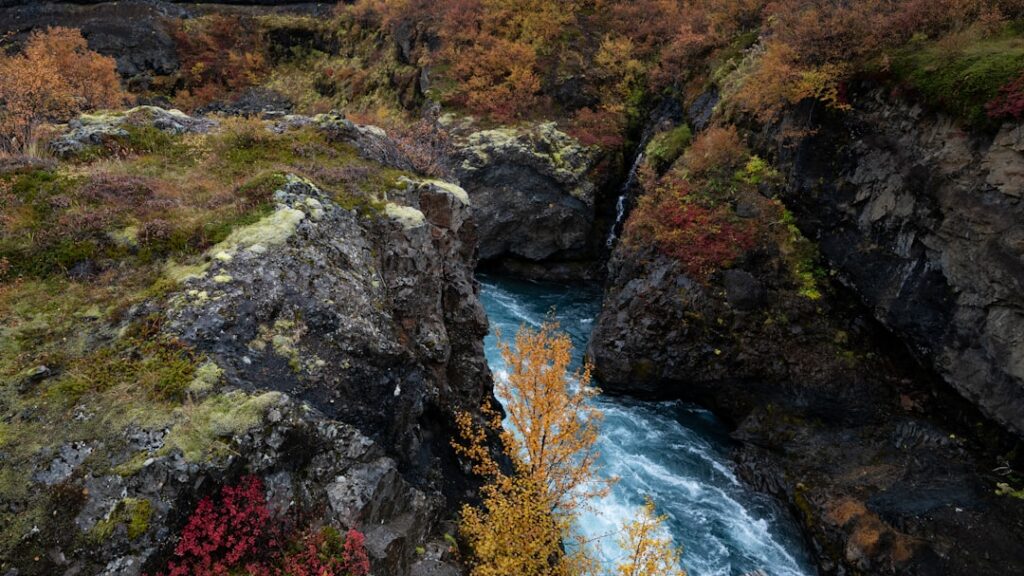
Letchworth operates on a different scale entirely. The Genesee River has carved a gorge up to 550 feet deep and 17 miles long, a landscape that earned the park its informal title, “The Grand Canyon of the East.” The three major waterfalls are visible from overlooks along the gorge rim, and the primary experience is looking down and across rather than looking up. Inspiration Point, on the east rim overlooking Middle Falls, is the park’s signature viewpoint: the 107-foot waterfall drops into the gorge with forested cliffs layered in fall color extending in both directions.
The scale is expansive. Where Watkins Glen wraps around you, Letchworth opens up in front of you. The emotional register is different: awe rather than wonder, grandeur rather than intimacy.
Trail Difficulty
Watkins Glen
The Gorge Trail is rated strenuous. The 832 stone steps are continuous, uneven, and often wet. The elevation gain is about 400 feet over 2 miles. The full out-and-back takes 1.5 to 2 hours at a moderate pace. The trail is not wheelchair or stroller accessible. People with knee problems should consider the Rim Trail instead, which runs along the top of the gorge with views down into the canyon and is significantly less demanding.
The strenuous rating is accurate but slightly misleading: the individual steps are not steep. The difficulty comes from the cumulative effect of 800-plus wet stone steps without a flat resting stretch. Most reasonably fit adults can complete it. Children over 6 generally manage fine, though they may need encouragement on the last third.
Letchworth
Letchworth offers a wider range of difficulty. The most popular viewpoints, including Inspiration Point, Middle Falls overlook, and Upper Falls overlook, are accessible from short walks (under a quarter mile) from parking areas along the main park road. You can see the gorge’s highlights without any significant hiking.
For hikers who want more, the park has over 60 miles of trails. The Gorge Trail descends from the rim to the river at several points, with elevation drops of 400 to 550 feet on steep, sometimes rough paths. The Mary Jemison Trail runs 7 miles along the east rim. The Finger Lakes Trail passes through the park’s southern section. The range of difficulty means Letchworth accommodates everyone from mobility-limited visitors who want a viewpoint to experienced hikers looking for a full day.
Crowds
Watkins Glen
The gorge is narrow, and the trail is a single path with limited passing room. On a July Saturday at noon, the experience can feel like walking through a busy subway corridor, except the corridor happens to have 19 waterfalls. The bottleneck is real. Arriving before 9 AM or after 4 PM on summer weekends makes a significant difference. Weekdays are consistently better. October weekends draw large foliage crowds but are less packed than midsummer.
Letchworth
Letchworth draws comparable total visitor numbers, but the park is dramatically larger (14,427 acres versus Watkins Glen’s 778 acres). The crowds disperse across 17 miles of gorge, multiple overlook areas, and 60-plus miles of trails. The main viewpoints at Middle Falls and Inspiration Point can be busy on October weekends and summer Saturdays, but the congestion never reaches Watkins Glen levels. Drive a mile past the popular overlooks and you can find near-solitude on any day.
Best Season for Each
Watkins Glen
The Gorge Trail is open from mid-May through early November. Water flow is highest in late May and June, making the waterfalls most dramatic. Summer brings the heaviest crowds but the most reliable weather. Early fall (September through mid-October) is the sweet spot: smaller crowds, fall color on the rim, and comfortable temperatures. The gorge is closed in winter due to ice.
Letchworth
Letchworth is open year-round, and every season delivers a different gorge. Spring (late March through May) brings peak water flow on the Genesee River, and the three waterfalls run at full power. Fall (mid-October) delivers the park’s most famous views: the gorge walls layered in red, orange, and gold foliage with waterfalls cutting through. Winter transforms the gorge into an ice landscape, with frozen waterfalls and snow-covered cliffs visible from the rim overlooks. Cross-country skiing and snowshoeing are available on groomed trails. Summer is pleasant but least dramatic, with lower water flow and full leaf cover that obscures some gorge views.
What Else Is Nearby
Watkins Glen
Watkins Glen sits at the southern tip of Seneca Lake, the center of the Finger Lakes wine region. The Seneca Lake Wine Trail starts within a 5-minute drive. Restaurants in the village and in Geneva (40 minutes north) provide strong dining options. The Corning Museum of Glass is 30 minutes south. A Watkins Glen visit pairs naturally with a broader Finger Lakes wine-and-gorge trip. The gorge is the punctuation mark, not the whole sentence.
Letchworth
Letchworth is more isolated. The park sits in a rural stretch of Livingston and Wyoming counties, and the nearest significant town is Geneseo (about 15 minutes from the Castile entrance). Rochester is 35 miles north. There is no wine trail nearby, no walkable village adjacent to the park, and limited dining beyond the Glen Iris Inn inside the park itself (which has a dining room with a view of Middle Falls and books up on fall weekends). Letchworth is a destination unto itself, best experienced as a full-day commitment.
The Verdict
Choose Watkins Glen If:
- You want to walk through a gorge, not look down at one.
- The walk-behind waterfall at Cavern Cascade is a priority.
- You are combining the gorge with Seneca Lake wineries, Corning, or a broader Finger Lakes trip.
- You prefer a defined, focused experience (one trail, 2 hours, clear beginning and end).
- You are visiting between mid-May and early November (the only window the gorge is open).
Choose Letchworth If:
- You want a grand-scale landscape with long views and multiple waterfalls.
- You have varying fitness levels in your group (overlooks require almost no hiking; rim trails offer a moderate challenge; gorge-floor trails are strenuous).
- You are visiting in winter or early spring, when Watkins Glen’s gorge is closed.
- You want to spend a full day in a single park with extensive trails, picnic areas, and varied terrain.
- You prefer to avoid the dense crowds of a narrow trail in peak season.
Do Both If:
You have three or more days in the Finger Lakes. The drive from Watkins Glen to Letchworth’s Castile entrance takes about 75 minutes via Routes 54 and 36. Seeing both gorges in a single trip provides the most complete picture of what New York gorge country delivers. Walk the gorge floor at Watkins Glen on Day 1. Stand on the rim at Letchworth on Day 2. The contrast between the two experiences, intimate versus panoramic, is the point.
Practical Comparison at a Glance
- Easier to visit with limited mobility: Letchworth (overlooks are steps from parking)
- Better for dogs: Letchworth (dogs allowed on most trails; dogs banned from Watkins Glen gorge floor)
- Better for photographers: Watkins Glen in the morning, Letchworth in the afternoon (Middle Falls faces east and catches afternoon light best)
- Better in October: Letchworth (the gorge depth and width showcase fall color more dramatically)
- Better in June: Watkins Glen (high water flow through a narrow gorge is extraordinary)
- More physically demanding: Watkins Glen Gorge Trail (continuous stone steps)
- More time required: Letchworth (a full day to see the main falls and drive the park road; Watkins Glen’s gorge is a 2-hour commitment)
- Better combined with other activities: Watkins Glen (wine trails and Seneca Lake dining are minutes away)