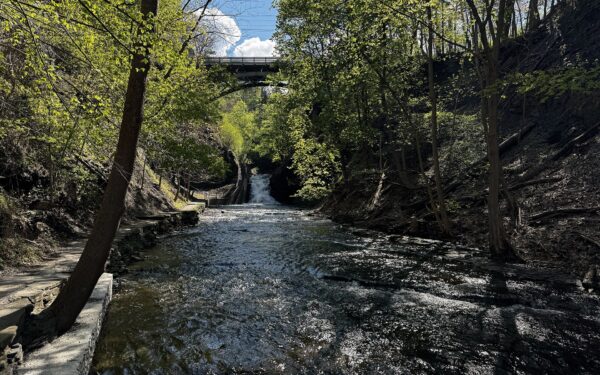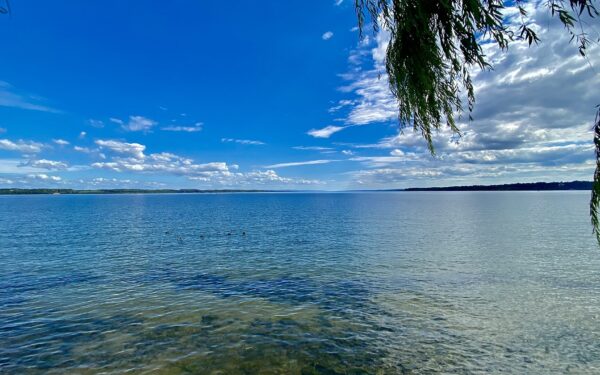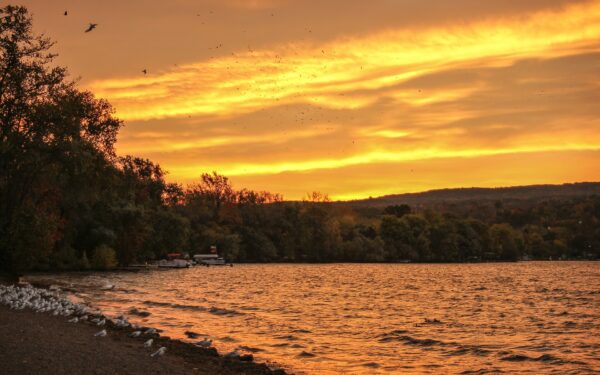
Seneca Lake is 618 feet deep and Cayuga Lake is 435. Water that deep warms slowly in spring, gives back its heat slowly in fall and rarely freezes across its whole surface, and it keeps the slopes around the two lakes a little milder than they would otherwise be. That helps open those hillsides to grape growing, European wine grapes included. The lakes soften frost and cold. They do not remove them.
How much water is in them
Seneca Lake is 38 miles long and about 3 miles wide at its widest, 618 feet deep at its deepest point, with an area of 43,343 acres. Cayuga Lake is 38 miles long and 3.5 miles wide at its widest, 435 feet deep at its deepest point, with an area of 42,956 acres and an average depth of 181 feet. Seneca has the largest volume of the Finger Lakes and is the deepest of the eleven. It holds just over half of all the water in the eleven lakes, roughly 4.1 trillion gallons, and Cayuga about 30 percent, roughly 2.5 trillion gallons. For more on Seneca’s depth and ice history, see How Deep Is Seneca Lake? (And Other Strange Facts).
How deep water stores heat
Water is slow to change temperature. It takes about 11 times as much heat to warm a pound of water by one degree as a pound of copper, and a large body of water takes longer to heat up and longer to cool down than land. In a deep lake the sun warms only the top layer. Sensors at Seneca’s deepest point recorded surface highs of 73 to 79 degrees over three summers starting in 2015, with the warm layer forming in late May and lasting until September.
Below the warm layer, past the thermocline, the water stays cold. The thermocline sits between 60 and 125 feet down on Seneca and about 70 feet down on Cayuga. Down there the water holds near 39 degrees, the temperature at which fresh water is densest. At 250 feet near Cayuga’s south end, it measures about 39 degrees all year.
Across a year the lakes gather heat from March to August and lose heat for the rest of the year. As the surface cools in fall, that water grows denser and sinks, and the lake turns over.
Why they rarely freeze over
A lake cannot freeze over until it has cooled all the way down. Surface water that cools toward 39 degrees sinks, so the lake keeps mixing until the whole water column is near that temperature. Only then can a thin layer of colder, lighter water sit on top and cool to 32. Most of the Finger Lakes form that layer in winter, with ice floating over 39-degree water below. Seneca and Cayuga are usually too turbulent for it. On Seneca, sensors found the water mixing from top to bottom all winter, which researchers put down to the lake’s small surface area for its volume and a steady winter wind. Ice usually forms only near shore and at the ends.
Ice has covered all of Seneca only a handful of times in recorded history, for a few days each time. Cayuga completely froze over in the winter of 1911 to 1912, when a student named Floyd Newman and his friends skated from Ithaca at the south end to the north end of the lake. It almost never freezes over completely. Wells College in Aurora, which closed in 2024, kept a tradition that no classes met on a day when Cayuga froze over.
Spring: a slower start
Land warms faster than water in spring, so vineyards close to a lake stay cooler. That delays budbreak, the moment buds open, and helps protect the vines from spring frost.
The lakes soften frost. They do not remove it. On the night of May 17 to 18, 2023, temperatures in the central Finger Lakes stayed below freezing from about midnight to dawn. Vineyards around Keuka Lake took the worst of it, with damage on about half their acres. On Seneca, vineyards at the north end suffered relatively little damage, while toward Dundee at the south end the damage was more consistent. Damage on Cayuga varied too.
Fall: some extra heat
In fall the land cools faster than the lake, so vineyards near the water get some extra heat. Seneca and Cayuga, the deepest and lowest of the lakes, give the most moderation and the longest growing season, while Keuka and Canandaigua, at higher elevation, are prone to earlier fall frosts than the area immediately around the larger lakes. Seneca’s lower east side is known locally as the Banana Belt for its warmth.
A 1988 federal rule for the Cayuga Lake wine area quoted a 1986 article that put the growing season on Cayuga’s slopes at 165 to 170 days, against an average of 145 days for much of the Finger Lakes. Those figures come from one article, not a federal measurement.
Winter: milder nights, with limits
Deep lakes that stay unfrozen keep the slopes around them slightly warmer in winter. In 2018 Neil Laird, an atmospheric scientist at Hobart and William Smith, said the lakes keep nearby areas several degrees warmer in winter and the summer maximum a little cooler. That is a general statement, not a vineyard measurement.
Measurements in the vineyards are more complicated. Cornell AgriTech tracked how cold hardy the buds were, not the air temperature, in 18 Riesling vineyards around the south end of Seneca for three winters, from 2022 to 2023 through 2024 to 2025. Hardiness differed between sites by up to 7 degrees Fahrenheit in the first winter and up to 8 in the second, with no consistent pattern by distance from the lake or by east side versus west side in those two winters. In the third winter, the lakeshore sites along the eastern shore typically had the lowest cold hardiness.
Cold is still the main limit on vinifera in the Northeast. Cornell research published in 2016 found that Merlot and Syrah buds show damage at about 0 degrees Fahrenheit, while Riesling and Cabernet Franc typically do better, with half of their buds dying only at temperatures down to about minus 13 in midwinter. A single freeze in January 2004 destroyed almost half of the Finger Lakes vinifera crop. The New York Wine & Grape Foundation warns that the lake effect may be growing less predictable as temperature swings and rainfall become larger and more erratic.
Slopes that drain cold air
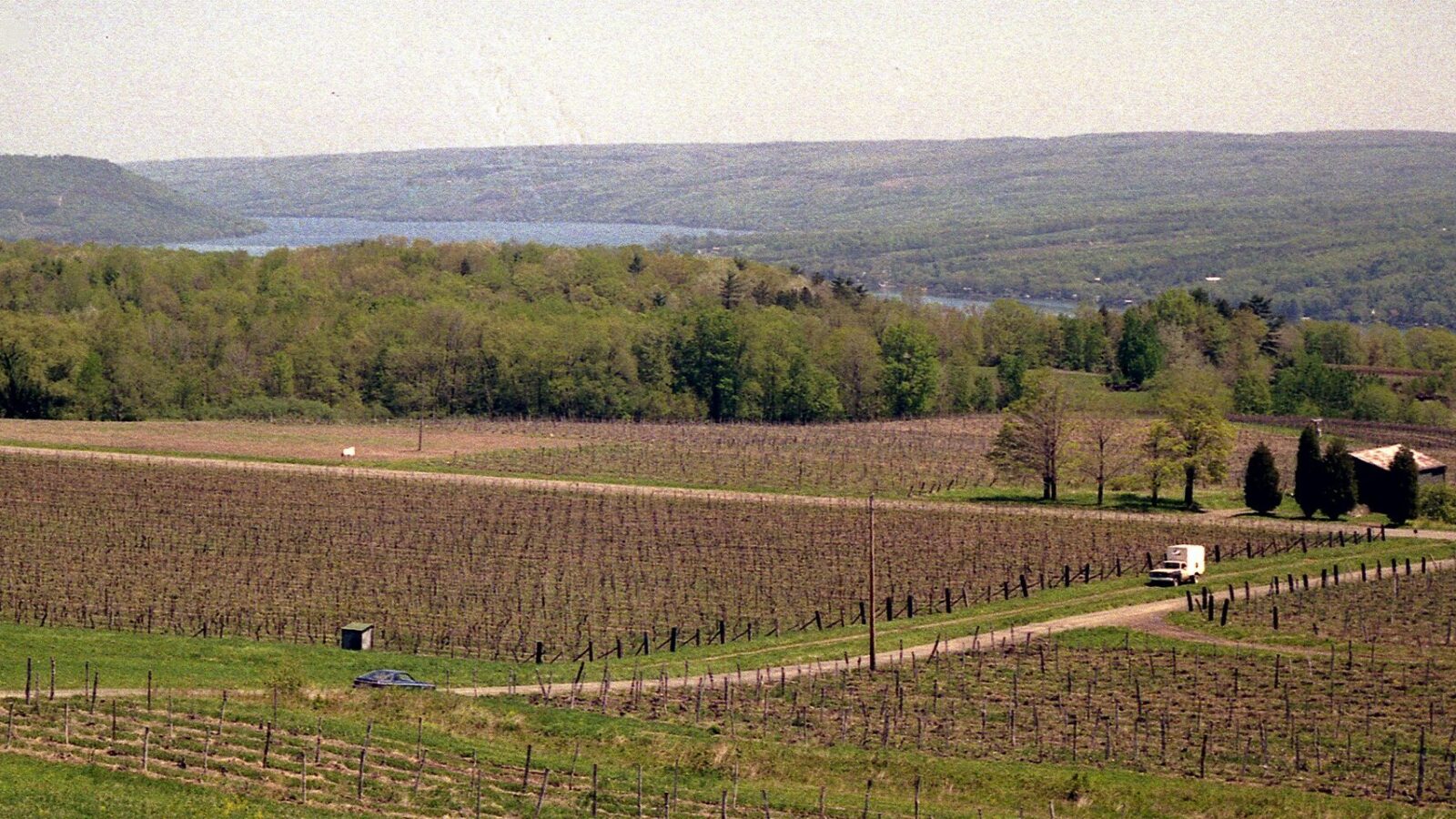
Cold air flows downhill and settles in low ground, where frost damage is most likely, so a site partway up a slope stays warmer than the bottom when nothing blocks the flow. The pool of cold air typically fills the bottom 25 to 30 percent of a slope’s height, and a band of warmer air forms above it on the middle of the slope, the part least at risk of winter injury. Around the Finger Lakes the hillsides rise 500 to 1,500 feet above the water. Within the Cayuga Lake wine area the land rises no more than 800 feet above the lake. That rule said Cayuga’s climate is created by both the lake and its adjacent hills, with cold air draining down the valley slopes and heat stored in the lake lowering the risk of an early frost.
A 2003 petition for the Seneca Lake wine area said the lake effect is strongest within about half a mile of the water, so tender vinifera varieties are planted close to it and hardier American varieties and hybrids higher on the slopes.
On Cayuga’s west side the slope is even enough that nothing interrupts the cold air draining off it, while on the east side uneven ground affects the airflow and the lake’s moderating effect. Hosmer Winery‘s Patrician Verona Vineyard, on the west side of Cayuga, sits on east-sloping land with silt loam over shale bedrock.
What the glaciers left
The lake valleys began as river valleys, and ice sheets up to two miles thick gouged them deeper. The most recent ice began melting away more than 12,000 years ago. Seneca and Cayuga were scoured so far that their floors lie below sea level: about 173 feet for Seneca, which has a surface elevation of 445 feet and a depth of 618, and about 54 feet for Cayuga, 381 feet up and 435 deep. A ridge of glacial debris, the Valley Heads Moraine, dams the south end of each lake and turned the streams around, so all eleven Finger Lakes drain north.
Under the hills is Devonian bedrock more than 360 million years old, mostly gray shale and silty limestone. Glacial till covers it, and vineyards on the four main lakes sit largely on limy till of shale, limestone and other glacial sediment. Soils run from well drained to moderately well drained, depending on the site, and shale splits into layers, so vine roots can follow the cracks. Lamoreaux Landing Wine Cellars in Lodi says its estate is entirely calcareous glacial till with a loam that drains well.
A 2005 research volume from Smith College and Hobart and William Smith found that old lake-level deltas left on hillsides beside the lakes can change vineyard soil sharply over short distances: their clay edges can drain poorly, while their coarse parts drain very well. It identified such deltas at vineyards on both lakes, among them Sheldrake Point Winery on Cayuga. Drainage matters because poorly drained clay-rich soil can push vines into excessive growth in wet years, and waterlogged soil greatly raises the risk of winter injury. The researchers concluded that the best grapes appear to come from soils that limit nutrients and moisture.
Konstantin Frank and the vinifera question
In the 1950s the common belief was that New York was too cold for Vitis vinifera, the species behind Riesling and the classic wines of Europe. Konstantin Frank, who arrived in New York in 1951, thought otherwise. Cornell’s account is that he saw the real obstacle as phylloxera, a pest that feeds on vinifera roots, and proposed grafting European vines onto American rootstock, as he had seen done in Europe.
Dr. Konstantin Frank Winery‘s own history says that at the Geneva experiment station in 1952 he was told of a well-established belief that the cold ruled vinifera out, and that Charles Fournier, president of Gold Seal Wines, hired him in 1954 as director of vineyard research. In 1958 he bought 188 acres on the western shore of Keuka Lake, and the first Vinifera Wine Cellars vintage came out in 1962. The winery is on Keuka, not on Seneca or Cayuga, but it also farms Riesling and Grüner Veltliner on Seneca’s east side. Cornell AgriTech’s Katie Gold credits Frank and a small group of wineries with building the modern vinifera industry hand in hand with Cornell.
Others followed on Seneca. Standing Stone Vineyards says Gold Seal’s Fournier and Guy Devaux planted four acres of Riesling in 1972 and eight acres of Chardonnay in 1974 on its site on Seneca’s east shore. Hermann Wiemer, who grew up on the Mosel in Germany, judged the soil and climate around Seneca similar to home. His winery, Hermann J. Wiemer Vineyard, near Dundee on Seneca’s west side, was founded in 1979, and its HJW Vineyard holds Riesling planted in the late 1970s.
Federal recognition came next. A rule published September 1, 1982 created the Finger Lakes wine area. The agency concluded that the growing season, the moderating effect of the lakes and air drainage on the slopes were significant, and it drew the boundary close to the lakes. Separate Cayuga Lake and Seneca Lake areas inside it followed, in 1988 and 2003. In 2024 the Finger Lakes had 832 acres of Riesling, about 90 percent of New York’s Riesling. For styles and where to taste them, see The Complete Guide to Finger Lakes Riesling.
Seeing it for yourself
Tastings are a good way to see the slopes and the water together, and some wineries teach the subject. Forge Cellars in Burdett, on Seneca’s southeast shore, offers guided Summer House tastings, by reservation only, that include a talk on glacial history, the lakeside microclimate and the soils. Lamoreaux Landing has lawn tables overlooking Seneca Lake. On Cayuga, Sheldrake Point has a 400-foot beach on the lake, with a gravel path along it to the tasting room across the street. Check each winery’s site before you go.
The Cayuga Lake Wine Trail was established in 1983 for wineries inside the Cayuga Lake wine area. Our Cayuga Lake Wine Trail tasting guide covers tasting on Cayuga’s slopes, and our map for planning a wine route on Seneca covers the other lake. To choose between the lakes for a visit, read Seneca Lake vs. Cayuga Lake: How to Choose, and for everything else on each lake, see the complete guides to Seneca Lake and Cayuga Lake.